
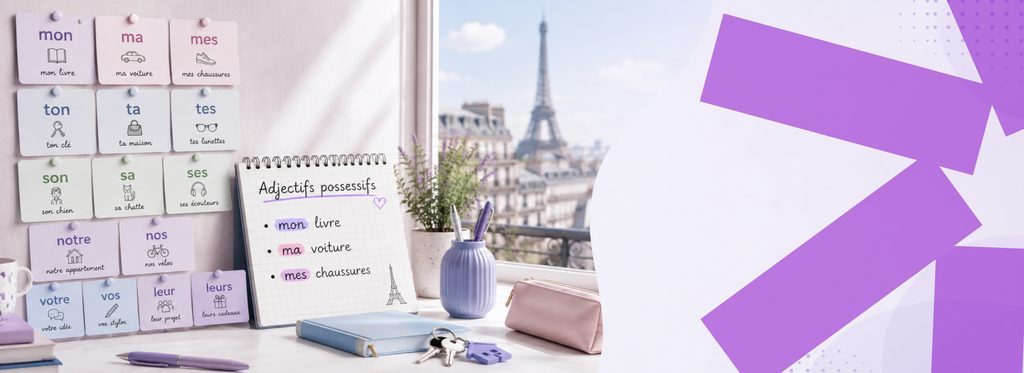
How to Use Possessive Adjectives in French
Possessive adjectives are words such as my, your, his, her, our and their.
In French, these words change depending on who owns something and on the gender and number of the noun being possessed.
For example:
mon manteau
my coat
ma veste
my jacket
mes chaussures
my shoes
The English word my stays the same. In French, we choose between mon, ma and mes.
In this lesson, we will learn how that system works.
What is a possessive adjective?
A possessive adjective tells us who something belongs to or is associated with.
For example:
mon livre
my book
ta voiture
your car
son frère
his / her brother
notre maison
our house
The possessive adjective comes before the noun.
The important difference from English is that French has several different forms of words such as my, your and his/her.
The French possessive adjectives
Here are the main forms:
| Owner | Masculine singular | Feminine singular | Plural |
|---|---|---|---|
| je | mon | ma | mes |
| tu | ton | ta | tes |
| il / elle | son | sa | ses |
| nous | notre | notre | nos |
| vous | votre | votre | vos |
| ils / elles | leur | leur | leurs |
So, for example:
mon livre – my book
ma voiture – my car
mes livres – my books
and:
ton livre – your book
ta voiture – your car
tes livres – your books
There are two things to think about
Choosing the correct French possessive adjective involves two questions.
1. Who does it belong to?
This tells us which family to use:
je → mon / ma / mes
tu → ton / ta / tes
il / elle → son / sa / ses
nous → notre / nos
vous → votre / vos
ils / elles → leur / leurs
2. What noun are we talking about?
The gender and number of the noun then tell us which form within that family to use.
For example, if something belongs to je:
le manteau is masculine → mon manteau
la veste is feminine → ma veste
les chaussures is plural → mes chaussures
So the owner chooses the family, while the noun chooses the form.
Mon, ma or mes?
Let’s start with the simplest family.
All three words mean my.
Use mon with a masculine singular noun.
Use ma with a feminine singular noun.
Use mes with a plural noun.
Ton, ta and tes
The same pattern applies to ton, ta and tes, which mean your when speaking to someone as tu.
Son, sa and ses
Son, sa and ses can mean his or her.
This is where French works differently from English.
Consider:
Paul cherche son téléphone.
Paul is looking for his phone.
But:
Marie cherche son téléphone.
Marie is looking for her phone.
In both sentences, French uses son because téléphone is masculine.
Now compare:
Paul cherche sa veste.
Paul is looking for his jacket.
Marie cherche sa veste.
Marie is looking for her jacket.
French uses sa because veste is feminine.
The gender belongs to the noun, not the owner
This is one of the most important things to remember.
son does not automatically mean his.
sa does not automatically mean her.
Instead:
son = masculine singular thing belonging to him or her
sa = feminine singular thing belonging to him or her
ses = plural things belonging to him or her
Context normally tells us whether the English translation should be his or her.
The owner changes, but the possessive stays the same when the noun stays the same.
veste is feminine → sa
What happens before a vowel?
There is one useful exception to the normal masculine/feminine pattern.
Before a feminine singular noun beginning with a vowel or a mute h, French uses mon, ton or son instead of ma, ta or sa.
For example:
mon amie
my friend
ton école
your school
son histoire
his / her story
The nouns are still feminine.
It is une amie, une école and une histoire.
French simply uses mon, ton or son here because they are easier to pronounce before the following vowel sound.
So:
ma sœur
but
mon amie
ta voiture
but
ton école
sa maison
but
son histoire
Notre and nos
For our, the pattern becomes simpler.
There is no separate masculine and feminine form.
Votre and vos
The same pattern applies to votre and vos.
Leur and leurs
Use leur when something belongs to ils or elles and the noun being possessed is singular:
leur maison
their house
leur voiture
their car
Use leurs when the noun being possessed is plural:
leurs enfants
their children
leurs valises
their suitcases
The difference is therefore very simple:
leur + singular noun
leurs + plural noun
Notice that it is the number of the thing possessed that matters.
leur voiture
their car
but:
leurs voitures
their cars
See the whole pattern
The system becomes easier when you look at the families together:
| English | French |
|---|---|
| my | mon / ma / mes |
| your – with tu | ton / ta / tes |
| his / her | son / sa / ses |
| our | notre / nos |
| your – with vous | votre / vos |
| their | leur / leurs |
You do not need to treat these as eighteen unrelated words. They form a small number of repeating patterns.
Practice: Mon, ma or mes?
Choose mon, ma or mes to complete each phrase.
Practice: Choose the correct possessive adjective
Choose the correct possessive adjective to complete each sentence.
The key idea
The easiest way to approach French possessive adjectives is to make two decisions:
Who owns it?
Choose the correct family: mon, ton, son, notre, votre or leur.
Then ask:
Is the noun masculine, feminine or plural?
Choose the correct form within that family.
So:
je + masculine noun → mon
je + feminine noun → ma
je + plural noun → mes
and the same principle carries through the rest of the system.
Go Deeper
Possessive adjectives are closely connected to the grammatical gender and number of nouns. If you are not yet comfortable deciding whether a French noun is masculine or feminine, or you want a refresher on nouns and plurals, definitely check out the related articles below:

Nouns and Making Plurals in French
It is important to know the gender of French nouns as many other words undergo changes that reflect the gender of the noun.

Nouns and Use of Gender in French
It is important to know the gender of French nouns as many other words undergo changes that reflect the gender of the noun.
Where next?
Possessive adjectives tell us that something belongs to someone:
mon livre
my book
Later, you may also meet forms which replace the noun completely:
le mien
mine
That is a different structure, known as a possessive pronoun, and is best learned separately once the possessive adjectives on this page are familiar.