
This lesson is part of the course(s):
French for Literature
What Are the Titles of Classic Novels in French and English?
In this lesson, we learn the translations and titles of classic French novels.
Watch the video as many times as you need, until you feel you can give the French translations as we go!
Review Vocabulary
Review the words from this video:
Part 1
| English | French |
|---|---|
| Dangerous Liaisons (Choderlos de Laclos, 1782) | Les Liaisons Dangereuses |
| Froth on the Daydream (Boris Vian, 1947) | L’Écume des Jours |
| In Search of Lost Time (Marcel Proust, 1908-22) | À la Recherche du Temps Perdu |
| Journey to the Centre of the Earth (Jules Verne, 1864) | Voyage Au Centre de la Terre |
| Journey to the End of the Night (Céline, 1932) | Voyage au Bout de la Nuit |
Part 2
| English | French |
|---|---|
| Memoirs of a Dutiful Daughter (Simone de Beauvoir, 1958) | Mémoires d’une Jeune Fille Rangée |
| My Father’s Glory (Marcel Pagnol, 1957) | La Gloire de mon Père |
| Nausea (Jean-Paul Sartre, 1938) | La Nausée |
| Promise at Dawn (Romain Gary, 1960) | La Promesse de l’Aube |
| The Count of Monte Cristo (Alexandre Dumas, 1844) | Le Conte de Monte Cristo |
Part 3
| English | French |
|---|---|
| The Flowers of Evil (Charles Baudelaire, 1857) | Les Fleurs du mal |
| The Imaginary Invalid (Molière, 1673) | Le Malade Imaginaire |
| The Lover (Marguerite Duras, 1984) | L’Amant |
| The Stranger (Albert Camus, 1942) | L’Étranger |
| The Three Musketeers (Alexandre Dumas, 1844) | Les Trois Mousquetaires |
Flashcards
Go Deeper
If you want to expand your knowledge about this topic, explore any materials below.
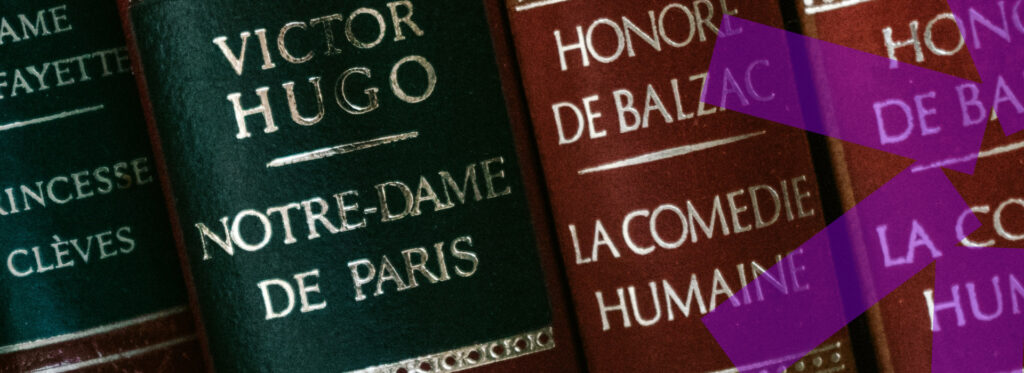
Discovering French Classics: A Beginner-Friendly Introduction to Iconic Works
Discover the essentials of French literature with simple, friendly summaries of famous classics—from Proust and…
Give It a Go!
If you’d like to test your knowledge of what you’ve learned so far, you can select from any quizzes or activities below.

French Quiz – Word Recall – French for Reading – Titles of Classic French Novels
A quiz to test your knowledge of the French titles of some classic French novels.
Congratulations! You’ve reached the end of this topic.