

Writing Business Emails in French: Applying, Responding, and Communicating Professionally
Email is one of the most common ways to communicate in professional French. Whether you are applying for a job, responding to a recruiter, or exchanging information with a company, French business emails follow clear conventions around tone, structure, and politeness.
Understanding these conventions will help you sound professional, confident, and appropriate — even if your French is still developing.
Getting Around the Email Client in French
Let’s get familiar with the email tool in French and the terms used. Below is an example from Outlook. See how many words you can work out simply from the context or the icon! Then check your thinking with the terminology list that follows.
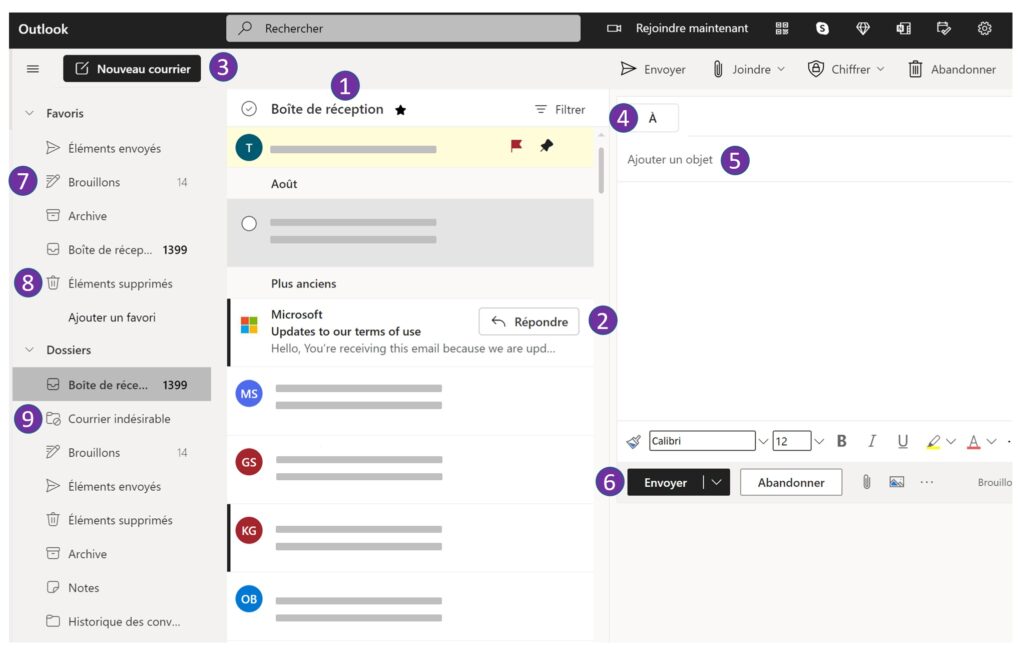
Finding your way around:
| No. | French | English |
|---|---|---|
| 1 | Boîte de réception | Inbox |
| 2 | Répondre | Reply |
| 3 | Nouveau courrier | New message |
| 4 | À | To |
| 5 | Objet | Subject |
| 6 | Envoyer | Send |
| 7 | Brouillons | Drafts |
| 8 | Éléments supprimés | Deleted items |
| 9 | Courrier indésirable | Junk mail / spam |
Cultural Note: Formality and Politeness in French Emails
OK, let’s get into writing the email, French proper next. So, first of all, French professional emails tend to be more formal than their English equivalents. Politeness formulas are important, especially when writing to someone you do not know personally.
Even short emails usually include:
- a greeting
- a clear purpose
- a polite closing
Being slightly too formal is generally safer than being too casual.
The Basic Structure of a French Business Email
Most professional emails in French follow a simple structure:
- Subject line
- Greeting
- Purpose of the email
- Key information or request
- Polite closing
- Signature
Once you are familiar with this structure, writing emails becomes much easier.
Writing a Clear Subject Line
The subject line (l’objet) should be short and informative.
Common examples include:
- Candidature pour le poste de…
Application for the position of… - Demande d’informations concernant…
Request for information regarding… - Suite à votre annonce
Following your job advert
A clear subject line helps your email get noticed and understood quickly.
Choosing the Right Greeting
If you know the person’s name:
Bonjour Madame,
Bonjour Monsieur,
If you do not know the name:
Bonjour,
Bonjour is neutral and widely accepted in professional emails.
Stating the Purpose of Your Email
French business emails usually state their purpose clearly and early.
Examples:
Je vous écris pour vous proposer ma candidature au poste de…
I am writing to apply for the position of…
Je vous contacte suite à votre annonce publiée sur…
I am contacting you following your advert published on…
Je me permets de vous écrire afin de…
I am writing to you in order to…
These phrases are polite and commonly used in professional contexts.
Referring to Attachments
When applying for a job, you will often need to mention attachments.
Veuillez trouver ci-joint mon CV et ma lettre de motivation.
Please find attached my CV and cover letter.
Vous trouverez en pièce jointe…
You will find attached…
Grammar pointer
Ci-joint and en pièce jointe are fixed expressions — you don’t need to modify them.
Making Requests Politely
French uses polite phrasing to soften requests.
Je reste à votre disposition pour toute information complémentaire.
I remain at your disposal for any additional information.
N’hésitez pas à me contacter si besoin.
Please do not hesitate to contact me if needed.
These phrases are standard and safe to reuse.
Ending the Email Politely
Closings are an important part of French business emails. They are usually longer than in English.
Common closings include:
Cordialement,
Bien cordialement,
For more formal emails:
Je vous prie d’agréer, Madame, Monsieur, l’expression de mes salutations distinguées.
You don’t need to invent your own closing — using a standard formula is expected.
Example: A Simple Job Application Email
Objet : Candidature pour le poste de chef de projet
Bonjour Madame,
Je vous écris pour vous proposer ma candidature au poste de chef de projet, suite à votre annonce.
Veuillez trouver ci-joint mon CV et ma lettre de motivation.
Je reste à votre disposition pour toute information complémentaire.
Cordialement,
[Votre nom]
This structure works for many professional situations.
Tone and Style Tips
When writing business emails in French:
- avoid slang or emojis
- keep sentences clear and direct
- don’t over-explain
- reuse standard phrases
Grammar pointer
French business emails often avoid je where possible by using polite formulas, but it is still acceptable to use je when stating your purpose.
Why This Matters
Being able to write professional emails in French allows you to move from understanding job adverts to actively applying and communicating with employers. These skills are essential in French-speaking workplaces and help you present yourself clearly and respectfully.
Even simple, well-structured emails make a strong impression.